Have you ever been in the middle of an argument with your spouse and suddenly realized, “Oh my gosh. We have had this exact fight before”?
Maybe the details are different. This time it’s the dishes. Last time it was sex. Before that it was the kids, money, your mother-in-law or the fact that somebody said they would be ready to leave at 6:00 and somehow interpreted that to mean they should start getting ready at 6:07.
But underneath the topic, the pattern feels strangely familiar. One person criticizes. The other gets defensive. Somebody shuts down. Resentment starts building. Before long, neither of you is really talking about the original issue anymore.
You’re riding the same old horse.
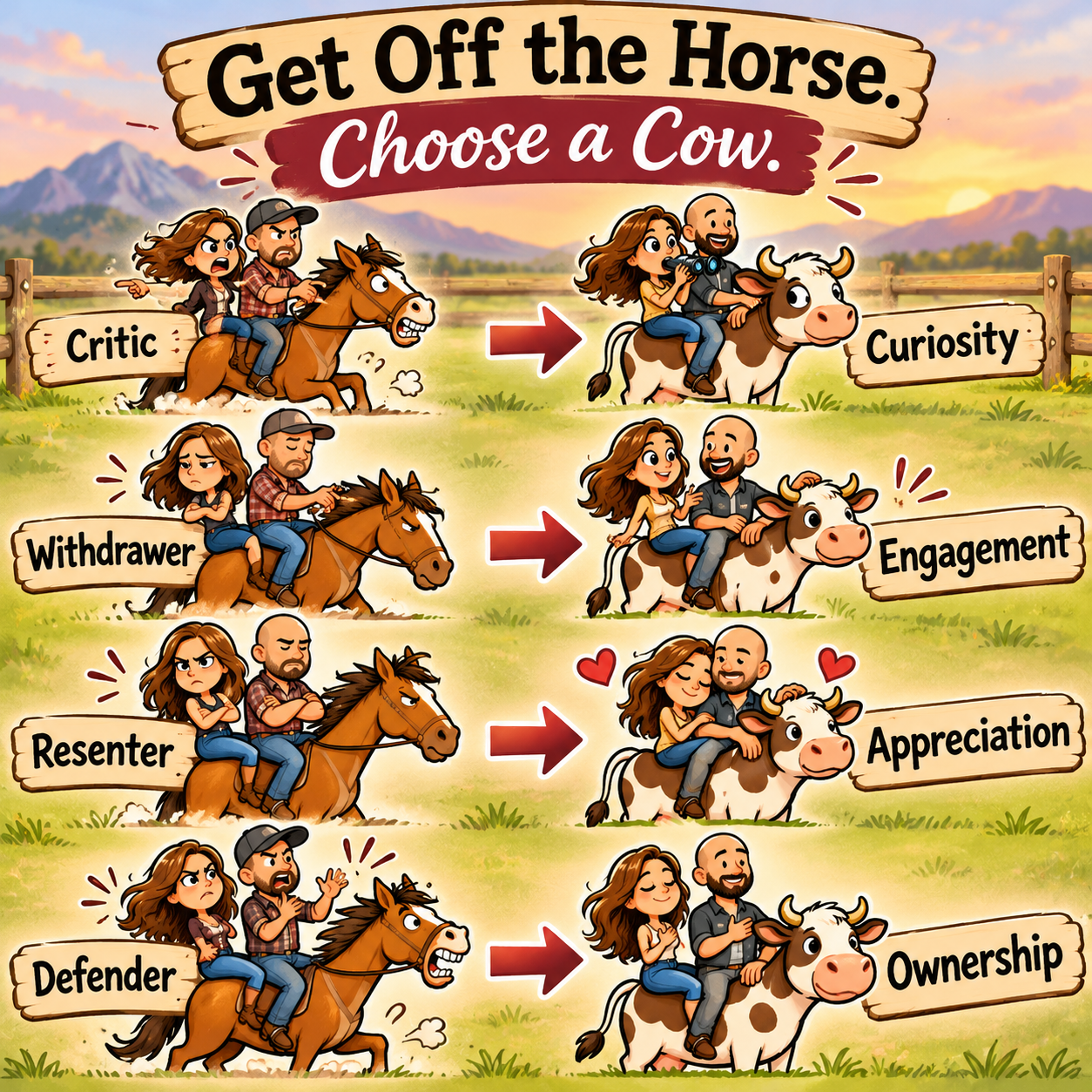
This is where one of my favorite slightly ridiculous relationship tools comes in: the horses and the cows.
I teach four common “horses” couples tend to ride when things get tense: Critic, Withdrawer, Resenter and Defender. The goal isn’t to figure out which horse your spouse is so you can point at them and say, “SEE! You’re doing the Defender thing again!” Please don’t do that.
The goal is to recognize the horse you are riding and decide whether you want to keep riding it. Because there’s another choice.
You can choose a cow.
The Four Horses We Keep Riding
The four horses are patterns we fall into when we’re uncomfortable, hurt, afraid, disappointed or trying to protect ourselves. Critic focuses on what the other person is doing wrong. Withdrawer checks out, shuts down or disappears from the conversation. Resenter keeps track of the hurt and may express it through sarcasm, contempt, eye rolling, irritation or quiet scorekeeping. Defender explains, justifies, counters or points back at what the other person did.
These patterns make sense. There is usually a reason we learned them. But understanding why you got on the horse doesn't mean you have to keep riding it.
That’s where the cows come in. The four cows are Curiosity, Engagement, Appreciation and Ownership.
Critic → Curiosity
Withdrawer → Engagement
Resenter → Appreciation
Defender → Ownership
The cow isn’t about becoming the “good spouse” while your partner gets to keep behaving badly. It’s about asking a much more useful question: Who do I want to be in this conversation?
Critic → Curiosity
Criticism often sounds like, “You never want to spend time with me,” “You're always on your phone,” “You don't care about our relationship,” or “You only think about yourself.”
There may be something important underneath those statements. Maybe you really are lonely. Maybe you miss your spouse. Maybe you want more intentional time together. But criticism takes a desire and turns it into a character assessment.
Instead, move toward curiosity. That might sound like, “I’ve been missing you lately. I’d really love some intentional time together. Would you be up for planning something?”
Or maybe curiosity needs to happen internally first. What am I actually wanting right now? What story am I telling myself about my spouse? What else could be true? What happens in me when they do this?
Curiosity doesn't mean you stop having an opinion. It means you stop treating your first interpretation as the only possible truth. Learning to choose curiosity instead of correction gives you somewhere different to go when you and your spouse see things differently.
That shift matters because when you become curious instead of corrective, there is suddenly room for another person in the conversation.
Withdrawer → Engagement
Some people protect themselves by leaving. Sometimes physically. Sometimes emotionally. They go silent, say “Whatever,” stare at their phone, leave the room or stop responding because the conversation feels overwhelming, pointless or unsafe.
Taking space isn't necessarily a problem. Sometimes taking a break is exactly what a conversation needs. The difference is whether you are taking space from the intensity or withdrawing from the relationship.
Engagement might sound like, “I’m getting overwhelmed and I need a few minutes. I promise I’ll come back.” That is very different from walking away and leaving your spouse wondering whether the conversation is over forever.
Engagement doesn't require you to stay in a conversation when you're flooded or unable to think clearly. It means you remain responsible for coming back. You can take a break without abandoning the conversation. You can need space without making your spouse chase you. You can say, “I don't know what to say yet,” and still remain engaged.
Sometimes learning how to stay in a difficult conversation means giving yourself time to process without disappearing from it completely. Choosing the cow may simply mean staying emotionally present long enough to say, “This is hard for me, but I don't want to disappear.”
Resenter → Appreciation
Resentment loves a scorecard. “I always do this.” “They never do that.” “I initiated the last three times.” “I’m the only one who plans anything.” “I shouldn't have to ask.”
Over time, you can become very skilled at noticing evidence that supports the story you already have about your spouse. If your story is, “I do everything around here,” your brain will become an excellent detective looking for every sock on the floor, every forgotten appointment and every dishwasher that somehow remains invisible to everyone except you.
Appreciation doesn't mean pretending those things don't matter. It means resentment doesn't get to be the only lens through which you see your spouse.
Can you notice what is going well too? Can you acknowledge an effort without immediately adding, “Finally”? Can you receive something good without explaining why it wasn't quite enough? Can you notice the ways your spouse is choosing you in the small moments that don't look exactly like the ways you choose them?
Appreciation isn't pretending your marriage has no problems. It’s refusing to let the problems become the only thing you can see.
Defender → Ownership
This might be the hardest cow.
Your spouse says, “I felt hurt when you said that,” and before they even finish the sentence, your brain is already preparing Exhibit A. “Well, I only said that because you…” “You do the same thing.” “That isn't what I meant.” “You're taking it wrong.” “Okay, but what about when you…”
Defensiveness wants to prove innocence. Ownership asks a different question: “What’s my part in this?”
Notice that ownership doesn't ask, “How is everything my fault?” Those are not the same thing.
You can disagree with your spouse's interpretation and still own your behavior. You can also listen to your spouse's experience without immediately explaining yourself. You might say, “That wasn't my intention, but I can see how what I said landed that way.”
You can recognize that your spouse also contributed to the conflict without needing to make their contribution the price of admission for acknowledging yours. You don't have to own 100 percent of a problem. You just have to be willing to own your part.
That is one of the biggest shifts I see when couples begin learning to choose each other without losing themselves. Ownership isn't submission. It’s being grounded enough in yourself that you don't have to make your spouse wrong in order to be okay.
The Goal Is Not to Identify Your Spouse’s Horse
This is important. Please do not read this article, identify all four of your spouse's horses and send it to them with highlighted sections.
That's just Critic wearing a cowboy hat.
The useful question isn't, “Which horse is my spouse riding?” It's, “Which horse am I riding right now?”
That question gives you somewhere to go. Maybe your spouse is being defensive and you're criticizing. You can choose curiosity. Maybe your spouse is resentful and you're withdrawing. You can choose engagement. And maybe your spouse isn't taking ownership and you desperately want them to. You can still ask yourself, “What is mine to own?”
Your spouse's cow belongs to them. Yours belongs to you.
Choosing a Cow Doesn't Guarantee Your Spouse Will Choose One Too
This is where relationship tools can accidentally become another invisible contract. “I was curious, so now you should stop being defensive.” “I appreciated you, so now you should appreciate me.” “I owned my part, so now it's your turn.”
Nope. Now we’ve just created a cow scorecard.
Choosing a different response because you are trying to make your spouse change isn't actually much of a choice. It's another strategy for controlling the outcome. The real work is being able to say, “This is how I want to show up because this is who I want to be.”
Your spouse still gets to choose how they respond. That doesn't mean their behavior has no impact on you. It doesn't mean you don't have boundaries or requests, and it certainly doesn't mean you remain in conversations where you are being mistreated. It means you stop making your growth dependent on whether your spouse goes first.
Sometimes You’ll Notice the Horse After You’re Already Galloping
You are not going to become perfectly curious, engaged, appreciative and accountable because you read one blog post. Sometimes you will recognize the horse immediately. Other times you'll recognize it twenty minutes into the argument, three hours later while replaying the conversation in your head or the next morning when you suddenly think, “Ohhhh. I was defending myself the entire time.”
Great. You noticed.
Awareness gives you somewhere to practice. You can go back and say, “I've been thinking about our conversation, and I realized I spent most of it defending myself. I wasn't really listening to what you were trying to tell me.”
That is repair. You don't have to catch every pattern before it happens. You can notice it, take ownership and choose differently the next time.
Make the Horses and Cows Your Shared Language
One reason I love giving couples simple language for patterns is that it can take some of the intensity out of what is happening. Instead of, “You're doing it again!” try, “Which horse are we riding right now?”
Not sarcastically. Not as a weapon. And preferably not while neighing at your spouse. Although if you both start laughing, I'm not necessarily against it.
The point is to interrupt the autopilot. Sometimes even bringing a little playfulness back into your marriage can help you step outside a familiar pattern long enough to see what you're doing.
Sometimes simply naming the pattern gives both people enough room to see it. “Oh. I'm defending.” “I think I've been criticizing.” “I just realized I checked out five minutes ago.” “I've definitely been keeping score.”
Now you aren't just inside the pattern anymore. You're looking at it. And once you can see it, you have a choice.
The Cow Might Feel Less Natural at First
Your horse is probably familiar. You have likely practiced it for years. Criticism may feel much more natural than vulnerability. Withdrawal may feel safer than engagement. Resentment may feel more justified than appreciation. Defending yourself may feel much easier than owning your part.
So when you try the cow, it may feel awkward. That doesn't mean you're doing it wrong.
If you usually criticize and suddenly say, “I actually think what I'm trying to say is that I miss you,” that can feel incredibly vulnerable. If you usually withdraw and say, “I need twenty minutes, but I promise I'm coming back,” you are doing something different.
And if you usually defend and instead say, “Yep. I can see my part in that,” your brain may immediately want to add a giant BUT. You may need to let the sentence end.
That is practice.
You Don't Need Your Spouse to Get Off Their Horse First
This might be my favorite part of the whole analogy. You get to choose your cow even when your spouse is still riding their horse.
Not because you are better, because you're the emotionally mature one or because you should tolerate everything. You get to choose because your behavior belongs to you. That is what choosing your spouse while still being responsible for yourself can look like in marriage.
It is easy to be curious when your spouse is being curious. It is easy to appreciate someone while they're appreciating you. It is easy to take ownership when the other person goes first. The harder work is deciding who you want to be when the other person isn't making it easy.
That doesn't guarantee a particular outcome. But it does mean you aren't handing your spouse responsibility for deciding who you become in the conversation.
Questions to Think About
Which horse do I tend to ride most often when I feel hurt or threatened?
What am I usually trying to protect when I criticize, withdraw, resent or defend?
Which cow feels hardest for me to choose?
What would curiosity sound like in a conflict we're having right now?
When I need space, do I communicate that I'm coming back?
Have I been keeping a quiet scorecard in my marriage?
What is one thing about my spouse I have stopped noticing or appreciating?
When I feel defensive, can I find even 5 percent that belongs to me?
Do I use relationship tools to understand myself or to diagnose my spouse?
Am I willing to choose who I want to be even if my spouse doesn't change first?
Get Off the Horse
You will probably ride all four horses at some point. So will your spouse. The goal isn't to build a marriage where nobody ever criticizes, withdraws, resents or defends. The goal is to get better at noticing when you've climbed onto one of those familiar patterns and remembering that you don't have to stay there.
Critic → Curiosity
Withdrawer → Engagement
Resenter → Appreciation
Defender → Ownership
You don't need to wait for your spouse to choose differently before you do. You don't need to win the argument first, and you don't even need to do it perfectly.
You just need to notice the horse you're riding and ask yourself:
“Is this where I want to stay?”
And if the answer is no?
Choose a cow.
Want Help Getting Out of the Same Old Marriage Patterns?
If you and your spouse keep having different versions of the same argument, the topic may not be the real problem. You may be caught in a pattern that both of you know very well but don't yet know how to interrupt.
In coaching, we can slow those patterns down, identify what each of you is doing when you feel threatened or disconnected, and practice responding from more curiosity, ownership and choice. The goal isn't to figure out which spouse is the problem. It's to help both of you see the pattern clearly enough that you can choose what you want to do next.
Schedule a Coaching Call With Tammy →
About Tammy
Tammy Camp is a Marriage & Intimacy Coach who helps individuals and couples build deeper connection through honest communication, play, curiosity and practical tools for intimacy. She believes love is worth choosing every day and that great intimacy isn't about performing for each other. It's about learning how to truly know and choose each other.